
Hamnet by Maggie O'Farrell
My fourth book of the year

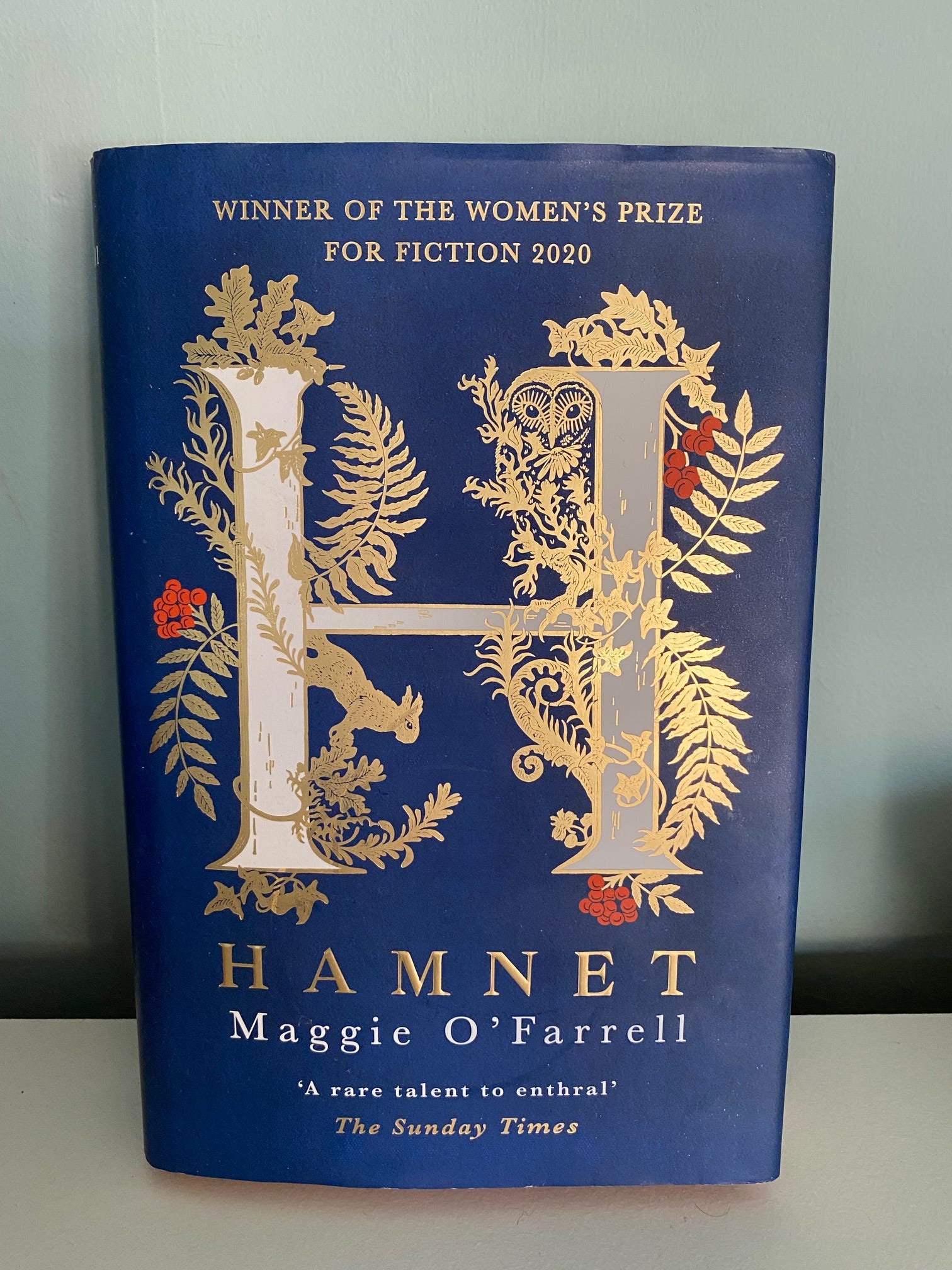
So far in this National Year of Reading, I haven’t bought any new books. At the end of last year, my daughter suggested buying Hamnet (Tinder Press, 2020) for me as a Christmas gift, since she knew the film was coming out but, once I’d heard the plot involved a child’s death, I said no. Then, when I saw a trailer for the film, I thought perhaps I should have said yes. Then there were advertisements, trailers, clips, snippets EVERYWHERE and I thought perhaps I should have tried to read the book before seeing the film. After that, the onslaught of film publicity turned me off both the idea of the book and the film, but, THEN, my friend Isy gave me her copy of the book, when I popped in to see her and her new baby. So, I started reading and, without meaning to, I still haven’t bought a new book.
I’m late writing this post, by the way. My intention in participating in a year of reading was, yes, to read more, and, also, to be offline more, and to scroll less. I’m fulfilling both intentions to a reasonable extent, so far. One reason is that I’m visiting a relative in hospital each week, so my time is taken up with that and has left little time to check in with Substack, or to be online at all.
To begin with, my latest book exasperated me. It seemed overwritten. At times, I felt furious with the book for slowing me right down when I wanted to race ahead. I wanted story, plot, dialogue, character development, action. Instead, the story seemed to crawl along, and the setting and time period were unfamiliar to me, unlike the easily recognisable, modern-day setting of my previous read. I didn’t look forward to picking up the book but instead found ways to avoid reading. I wrote in my diary “I’ll give this book to the end of the week and then give up.”
Then, something mysterious happened. It was if Agnes, the book’s central character and Hamnet’s mother, sensed my reluctance to throw myself into the book and, in the same way she uses herbs and folklore to ease people’s pains and troubles, she seemed to reach through the pages and bewitch me into becoming fully engaged with the story. I felt myself slowing down and feeling calmed by the pace of the narrative. I began to feel more comfortable in the setting and felt aware of myself becoming a different kind of reader, as if I was actively within the story but also aware of myself outside of it and and reading about it . I felt a little divided, rather like Agnes tending to her daughter Judith when she first has symptoms of The Black Plague:
Agnes seems to split in two. Part of her gasps at the sight of the buboes. The other part hears the gasp, observes it, notes it: a gasp, very well. Tears spring into the eyes of the first Agnes, and her heart gives a great thud in her chest, an animal hurling itself against its cage of bones. The other Agnes is ticking off the signs: buboes, fever, deep sleep. The first Agnes is kissing her daughter, on the forehead, on the cheeks, at the place where hair meets skin on her temple; the other is thinking, a poultice of crumbed bread and roasted onion and boiled milk and mutton fat, a cordial of hips and powdered rue, borage and woodbine.
As the story progressed and tragedy struck, I began to be profoundly moved. So very deeply and quite painfully. It was one of the reasons I avoided the story in the first place. I haven’t lost a child, although I have experienced miscarriage, but my mother lost two children, one at six weeks old, one at two and a half years - two of my brothers who died before I was born. So unexpectedly that it shocked me, this book connected me with my mother’s pain and loss, and with my own experience of bereavement (both of my parents died when I was young).
Maggie O’Farrell also writes well about two loving yet disparate characters living within an intimate relationship. In this extract, Agnes and her husband, their baby first-born child Susanna besides them, grapple to understand one another in the night:
In the still of the night, she whispers to him, asks him what is wrong, what is on his mind, can she help him? She puts her hand to his chest, where she feels his heart tap against her palm, over and over, as if asking the same question and getting no answer.
‘Nothing,’ is what he replies.
‘It must be something,’ she says. ‘Can you not say it?’
He sighs, his chest lifting and falling under her hand. He fidgets with the sheet edge, rearranges his legs. She feels the scrape of his shin against hers, the restless tug of the sheet. The bed-curtains are close around them, forming a cave where the two of them lie together, with Susanna asleep on the pallet, arms flung wide, her mouth pursed, hair plastered to her cheeks.
‘Is it…’ she begins, ‘…are you… do you wish we had not…wed? Is that it?’
‘He turns to her, for what feels like the first time in many days, and his face is pained, aghast. He presses his hand down on top of hers. ‘No,’ he says. ‘Never. How could you say such a thing? You and Susanna are all I live for. Nothing else matters.’
‘What is it then?’ she says.
He lifts her fingers, one by one, to his lips, kissing their tips. ‘I don’t know,’ he says. ‘Nothing. A heaviness of spirit. A melancholy. It’s nothing.’
She is just falling asleep, when he says, or seems to say, ‘I am lost. I have lost my way.’
He moves towards her, then, and grips her round the waist, as if she is drifting away from him, into huge, tidal waters.
Although never named as William Shakespeare, Agnes, her playwright husband, and their family live in Stratford-upon-Avon (although the playwright has to spend much time in London),in the late 1500s. The book’s introduction plainly states that it is a work of fiction, so a few esteemed Shakespearian experts who have questioned the accuracy of the story are rather missing the point, in my view.
It’s been a long time since I was so moved by a book. What an extraordinary phenomenon reading can be. I still haven’t seen the film - I think I need a little distance from the effect the book had on me before I book any tickets.